Why do turbines sometimes stand still?
How can it be that the wind turbine is stationary, it’s windy today, right? A question every GreenTruster has been asked at one time or another, whether during an information evening at work or a Friday afternoon drink with friends. A stationary turbine raises questions: is there a malfunction, or can’t the grid handle the power? In reality, downtime is often a conscious choice. There may be technical, environmental, financial or grid-related reasons why a wind turbine is temporarily not running. We clarify the possible causes of downtime.
Too little or just too much wind
The most logical reason is the wind itself. A turbine needs a minimum wind speed to turn, usually around 3 meters per second. Below that limit, turning produces less than it costs, so the turbine stays turned off. In severe storms, starting at about 25 meters per second (wind force 10), the plant actually shuts itself down. This is a safety measure to prevent damage to the machine. Once the wind subsides, the turbine restarts automatically.
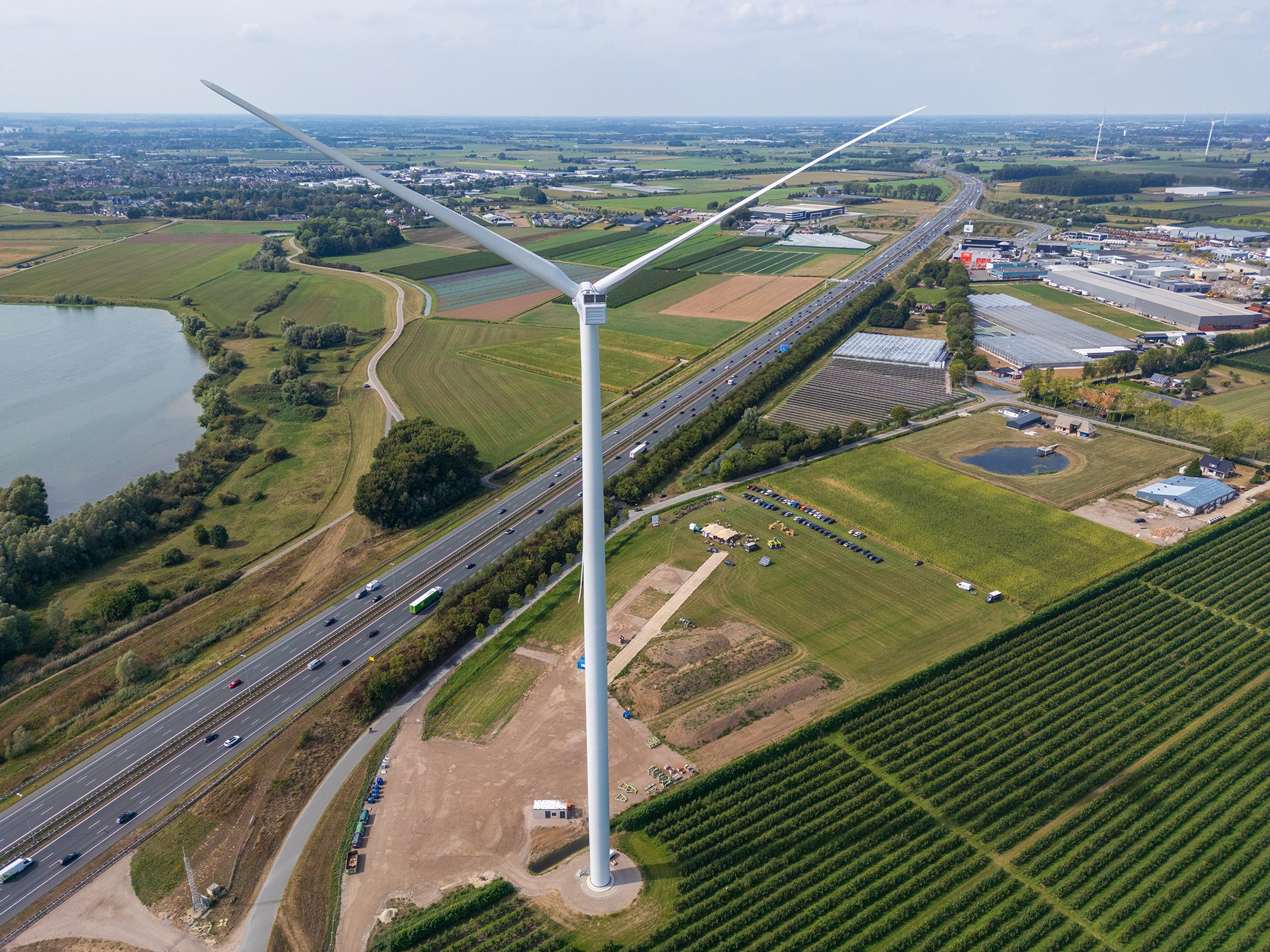
Maintenance and inspections
Wind turbines are complex machines with hundreds of moving parts. To keep them running safely and reliably, regular maintenance is necessary. Usually these are arranged once or twice a year by our asset management team during scheduled maintenance events. Engineers check the gearbox, bearings, hydraulic systems and safety sensors. There are also periodic inspections with drones or cameras to check the blades for wear or small cracks. Sometimes a turbine is also stopped briefly for software updates or sensor calibrations. Such downtime often lasts only a few hours, but ensures that the plant continues to perform optimally. The maintenance work usually takes place during the day, making it visible to many people that the turbines are shut down then. Outside these hours, they are running again.
Protection of birds and bats
Another reason for temporary downtime has to do with nature. In the Netherlands, many wind parks are required to take into account migration routes of birds and bats. During certain periods or under specific weather conditions, turbines are temporarily shut down to avoid collision victims.
The civilian wind park deals with bats. Under specific conditions (time of year, wind speed, time of day, temperature, precipitation) the wind turbines are stopped. Using a system with acoustic sensors, ultrasonic sounds are recorded to optimize the shutdown. These smart systems make it possible to reduce the impact on nature without losing energy production unnecessarily.
Negative power prices
A growing cause of downtime is downtime due to negative power prices. The price of power comes about through supply and demand. If there is more supply than demand for power, the price can temporarily become zero or even negative. This occurs, for example, on windy days with lots of sunshine. When the power price is negative, the wind park must pay money to supply power to the grid. Often it then makes more economic sense to shut down the wind turbines until the power price is positive again.
The power grid is filling up
Another possible cause of downtime is tightness on the power grid. More and more renewable power is being generated in the Netherlands, especially at times when the sun shines and the wind blows hard. This is good news, but the electricity grid cannot always handle these peaks. When the supply of power exceeds demand, or when the grid is full, the grid operator can ask (or oblige) wind parks to temporarily supply less or no power. This is necessary to prevent overloading and outages. At such times, the turbine is technically ready to run, but may not supply the power generated. Solutions are being worked hard: expansion of the power grid, local energy storage in batteries, and better coordination between wind, solar and consumption. Until then, standstill is unfortunately part of the reality of the energy transition.
Achieve maximum amount of cast shadow or noise
Sometimes a turbine is shut down because the legal limits for cast shadow or noise are almost reached. Wind turbines are only allowed under Dutch rules to cause a limited amount of nuisance to local residents.
There is a maximum of 17 days per year and 20 minutes per day on homes for cast shadow (the moving shadow of the blades). The wind turbines are equipped with sensors and automatic control systems that track exactly how much cast shadow has already occurred. Once the limit is nearly reached, the turbine temporarily shuts down at times when the sun is shining and the cast shadow would fall on a residence.
Noise is also strictly regulated. The noise standards are laid down in the Living Environment Activities Decree (Bal). These stipulate that the annual average noise level may not exceed 47 dB Lden (averaged over the day, evening and night) and 41 dB Lnight (averaged over the night). To stay within these limits, wind turbines can be automatically throttled back or temporarily shut down at certain times – for example, during high winds at night.
Icefall from wind turbines
In winter, the blades of a wind turbine can become covered with ice under certain conditions, such as fog, precipitation and temperatures around or below freezing. Once the turbine starts rotating again or the temperature rises, small or larger pieces of ice may come off. To prevent risks, turbines are automatically shut down in such situations through the so-called ice protocol. This protocol ensures that the turbines do not start up again until sensors or visual checks indicate that the ice has completely disappeared.
Testing, safety and environment
Safety also plays a role. When work is carried out on nearby high-voltage power lines, cables or other infrastructure, turbines are temporarily shut down. They are also shut down during test procedures or in the start-up phase of a new wind farm.