Beyond the net
Egchelse Heide energy hub as solution to grid congestion
In almost all of Europe, renewable energy growth is no longer limited by technology, but by grid congestion. This bottleneck increasingly acts as a brake on further expansion, but also provides new solutions. While many projects have to wait for grid reinforcement, wind farm Egchelse Heide is working on a local solution. Here, new sustainable projects and industrial customers will soon be able to use a single system together.
From wind farm to energy hub
Windpark Egchelse Heide, in the municipality of Peel and Maas, consists of five wind turbines and is central to this development. The wind farm is co-owned by GreenTrust and commissioned five years ago. The farm is now developing into the backbone of a local energy hub. This hub connects multiple producers and customers through a shared infrastructure.
“Instead of waiting for grid expansion, which could take years, we are developing a privately managed system. First through cable pooling and later possibly through a Closed Distribution System (GDS). This will allow multiple plants to share one grid connection. The goal is to bring wind, solar, storage and industry together in one integrated system,” said Jeroen Boerkamps, director of GreenTrust Group and Egchelse Heide.
Expanding with solar and local cooperation
A nearby solar farm, currently in the final stages of licensing, is expected to be one of the first additions to the energy hub. Since it does not yet have its own grid connection, ways to connect it to the wind farm’s existing infrastructure are being explored.
At the same time, energy cooperative Peel Energie, co-owner of the wind farm, is in talks to take over a 50% stake in this solar project from a local village cooperative. This will keep an important part of the project in local hands.
Energy storage as a link in the system
The current grid connection does not have enough capacity to fully handle both wind and solar production. Therefore, a battery system of minimum 20 to maximum 90 MWh is also being considered. With this storage, supply and demand can be better matched. This helps to limit disconnection and utilize more energy locally.
Connecting industry to the energy hub
The final size of the system depends on the design of the hub and the number of parties connected. One of the potential participants is a nearby brick factory. This company has plans for an electrolyser of 2x 2.5 MW for hydrogen production. This could replace about 2.5 million m³ of natural gas annually.
The plant will operate “behind the meter. This means that electricity will come directly from the energy hub, without using the public grid. A separate cable connection of about 3.5 kilometers will be constructed for this purpose, with an investment of about €1 million.
Further expansion in the region
In addition, further expansion is being considered. A nearby greenhouse area, which currently consumes about 8 million m³ of natural gas annually, offers great opportunities for electrification. By connecting these businesses to the energy hub, the switch from fossil fuels to renewable electricity can be made.
Further expansion in the region
In the vicinity of the greenhouses, Peel Energie is also developing a solar project next to the A67. Although this project has already been licensed, a grid connection is still missing. Connection to the energy hub via the same local grid is therefore obvious.
In its final form, the Peel and Maas energy hub could consist of the existing wind farm, two solar farms, a battery storage system, an industrial hydrogen user (brick factory), energy-intensive greenhouse horticulture and electric vehicle charging infrastructure.
“It’s a complex system, but the logic is simple: connect production and demand where the grid falls short,” Boerkamps said.
Toward a closed distribution system
The long-term goal is to achieve a closed distribution system: a private, local network operating alongside the public grid. This requires regulatory approval and must be developed within a tight schedule, as some partners work with fixed investment deadlines.
“The development of such a system is complex and requires technical, legal and commercial coordination between different parties. But the core is clear: in an environment with limited grid capacity, local energy systems offer a practical solution for integrating new renewable generation and utilizing it directly locally,” says Jeroen.
Energy hubs as solution to grid congestion
When these processes and collaborations fit together well, the energy hub at Egchelse Heide wind farm shows how separate energy projects can grow into a single integrated system. In it, production, storage and off-take are connected, to the benefit of all parties involved.
As long as grid congestion persists, these types of solutions are expected to be used in more and more places.
Also an issue due to grid congestion? Contact us. We are happy to think with you about a practical solution.
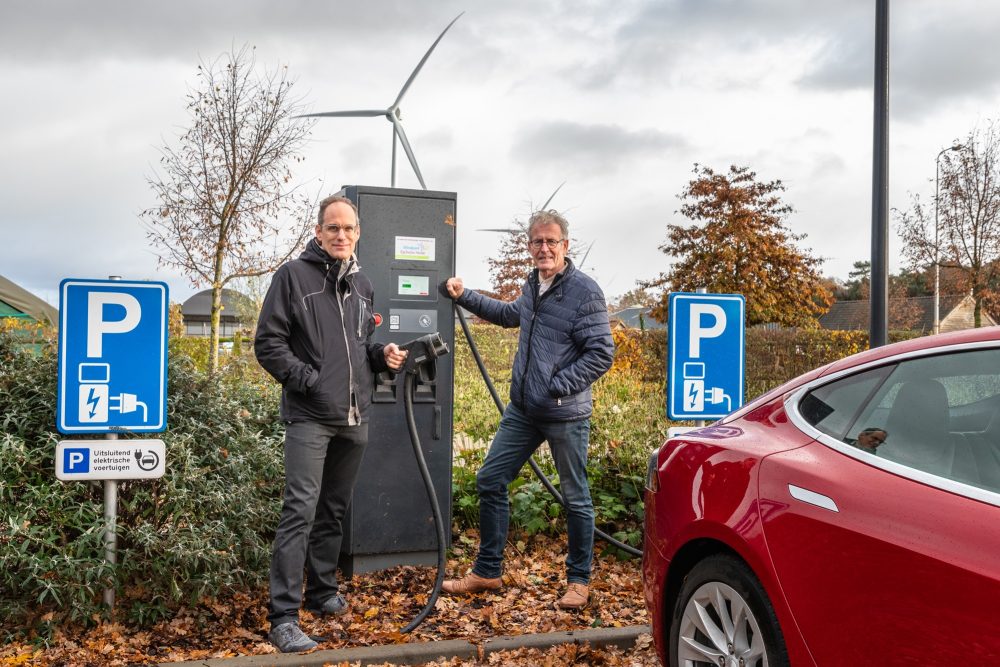
Photo: Jeroen Boerkamps (left) at the Egchelse Heide charging station
Team
Meet the GreenTrusters behind this news